
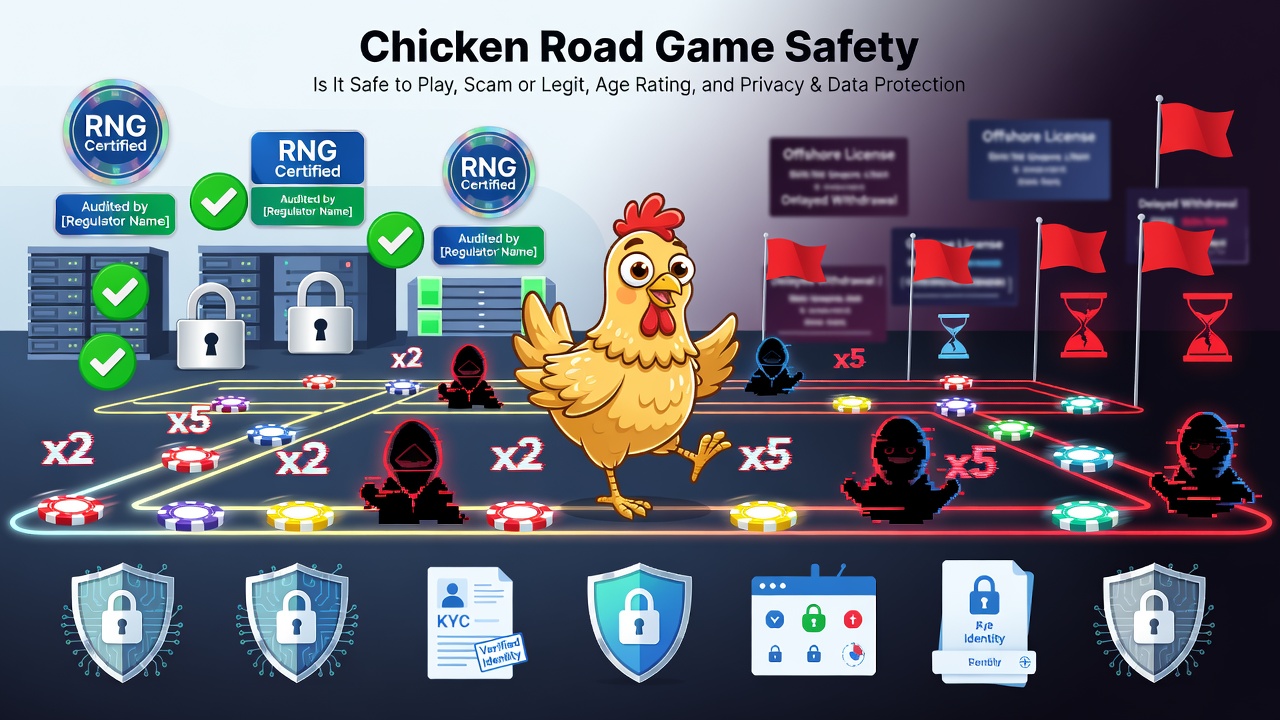
A crash-style game built around a chicken crossing a lane of increasingly dangerous obstacles sounds almost too simple to raise questions about safety. Yet the simplicity is precisely why so many players pause before depositing real money or handing over an email address. The mechanics look like a mobile arcade title, but the money on the table behaves like a casino wager, and that combination - casual presentation, real financial stakes - is exactly where scrutiny becomes necessary.
This matters because the game sits at an intersection of entertainment and gambling regulation, and not every platform hosting it applies the same standards. Some operators run fully licensed, audited versions with transparent payout logic. Others repackage the concept under different names with far less oversight. Before committing funds or personal details, a reasonable player wants a direct answer to one question: is chicken road game safe to play, and does the answer change depending on where you play it? A detailed breakdown from betfm, is chicken road game safe, addresses exactly this gap by comparing licensed operators against unregulated clones. The rest of this piece walks through the technical, legal, and practical angles - fairness mechanisms, licensing signals, age restrictions, and how your data gets handled - so you can make that judgment yourself rather than relying on marketing copy.
Understanding Chicken Road Game Safety
Safety in this context covers more than whether the app crashes or freezes mid-round. It spans three distinct layers: the fairness of the underlying algorithm, the legitimacy of the platform hosting it, and the protection of whatever personal or financial information you provide during signup and play. Each layer can fail independently of the others - a game can have a mathematically sound random number generator while still being hosted on a platform with poor withdrawal practices, for instance.
How the Game Mechanics Work
Chicken Road belongs to a family of games often called "crash" or "multiplier" games. A character - here, a chicken - advances across a series of lanes, and each successful step increases a payout multiplier. The player decides when to cash out before a random failure event ends the round. The core safety question is whether that failure event is genuinely random or manipulated to favor the house beyond the stated odds.
Random Number Generation and Fairness Audits
Legitimate versions of the game rely on certified random number generators (RNGs) that third-party testing labs periodically audit. These audits confirm that outcomes aren't predetermined or skewed beyond the disclosed house edge. Provably fair systems, which let players verify a round's outcome using cryptographic hashes, add another layer of transparency. Platforms that refuse to disclose their RNG provider or audit history warrant caution.
Common Red Flags on Unregulated Platforms
- No visible licensing information or vague references to "offshore" registration
- Payout percentages that are never disclosed or that change without explanation
- Withdrawal delays justified with shifting or inconsistent reasons
- Customer support that disappears once a withdrawal request is filed
Is Chicken Road Safe to Play? Evaluating the Evidence
Answering whether the game itself is safe requires separating the game's design from the operator running it. The underlying concept - a step-based multiplier game with a cash-out decision - is not inherently riskier than roulette or dice games. What varies enormously is execution quality and regulatory accountability from one site to another.
Licensing and Regulatory Oversight
Reputable operators hold licenses from recognized gambling authorities that require regular financial audits, dispute resolution mechanisms, and responsible gambling tools. A license number displayed in a site footer means little unless it can be verified against the regulator's public database. Cross-checking that number takes under a minute and eliminates a large share of fraudulent claims.
Payout Transparency and RTP Disclosure
Return-to-player (RTP) figures should be published and consistent across game sessions. Operators who advertise unusually high RTPs without third-party verification are often compensating for a lack of trust with unverifiable promises. Genuine platforms publish RTP ranges - typically in a band consistent with industry norms for similar crash-style games - and update them only after formal audits.
User Reviews and Independent Testing Reports
Independent review aggregators and gambling forums often surface patterns that individual players miss: recurring withdrawal complaints, sudden changes in terms of service, or coordinated account suspensions right before a payout. These reports don't replace formal audits, but they act as an early warning system when something shifts on a platform that previously seemed stable.
Chicken Road Game Scam or Legit: How to Tell the Difference
The scam-versus-legitimate question rarely has a universal answer because "Chicken Road" isn't a single trademarked product - it's a game format that dozens of platforms replicate under similar names. That fragmentation is precisely what scammers exploit, cloning the visual style of a trusted version while stripping out the fairness mechanisms underneath.
Signs of a Legitimate Operator
- Clear licensing details verifiable through an official regulator database
- Published RTP and volatility information for the specific game variant
- Responsive, documented customer support with multiple contact channels
- Consistent withdrawal processing times matching stated policies
Warning Signs of a Fraudulent Clone
Fraudulent versions frequently use near-identical branding to a known legitimate title but host it on a domain with no verifiable ownership or licensing history. Watch for aggressive bonus offers with impossible wagering requirements, forced minimum deposits before any withdrawal is permitted, and terms of service that change after you've already funded an account.
Verifying Platform Legitimacy Before Depositing
Run a basic checklist before any deposit: confirm the license number independently, read the terms of service for withdrawal caps or hidden fees, search for the platform name alongside terms like "withdrawal complaint" or "payout delay," and test customer support responsiveness with a pre-deposit question. A legitimate operator answers promptly; a scam operation often stalls or gives generic, scripted replies.
Chicken Road Game Age Rating and Player Eligibility
Because the game involves real-money wagering on most platforms, age restrictions aren't a formality - they're a legal requirement tied to gambling regulation in most jurisdictions. The chicken road game age rating typically aligns with standard gambling thresholds rather than general app-store content ratings.
Minimum Age Requirements Across Platforms
Most licensed gambling platforms hosting this game enforce an 18+ or 21+ minimum age, depending on the jurisdiction's gambling laws. Free-to-play or demo versions marketed through general app stores sometimes carry lower content ratings (commonly 12+ or 16+) because no real money changes hands, but this distinction confuses many players who assume the rating applies universally.
Age Verification Processes During Signup
Regulated operators require identity verification - typically a government-issued ID and sometimes a proof-of-address document - before allowing withdrawals, even if initial browsing or small deposits are permitted without full verification. This "know your customer" (KYC) process exists specifically to prevent underage access and to comply with anti-money-laundering rules.
Parental Controls and Restricting Access
Device-level parental controls, app-store purchase restrictions, and gambling-specific blocking software (such as tools that filter gambling domains at the router or ISP level) provide additional protection where platform-side verification alone isn't sufficient. Families sharing devices with minors should treat any real-money version of this game the same as they would a casino app.
Chicken Road Game Privacy and Data Safety
Beyond financial fairness, the game asks players to hand over personal data - email addresses, payment details, sometimes government identification. How that information gets stored, encrypted, and shared determines whether a platform's privacy posture matches its gambling license credibility.
What Personal Data the Game Collects
Typical data collection includes account credentials, device and browser fingerprints, payment method details, transaction history, and - for KYC-compliant operators - identity documents. Some platforms also track gameplay behavior to detect problem gambling patterns, which, while privacy-sensitive, generally serves a protective rather than exploitative purpose when disclosed properly.
Encryption and Secure Payment Handling
Legitimate platforms use TLS encryption for data in transit and store payment details through PCI-DSS compliant processors rather than retaining raw card numbers on their own servers. Absence of visible SSL certificates (the padlock icon in a browser address bar) or vague payment processing descriptions are immediate red flags.
Third-Party Data Sharing Policies
Privacy policies should specify exactly which third parties - payment processors, marketing partners, regulatory bodies - receive player data and why. Vague language like "affiliated partners" without named categories or purposes signals a policy written to permit broad data monetization rather than to inform users.
How to Check a Platform's Privacy Practices
- Read the privacy policy for specific retention periods, not just categories of data collected
- Confirm the platform names its payment processor and encryption standard
- Look for a data protection contact or officer listed for GDPR or equivalent regional compliance
- Check whether account deletion actually removes data or merely deactivates the account
Practical Steps for Playing Chicken Road Safely
Once licensing, fairness, and privacy checks are complete, a few behavioral habits reduce risk further regardless of which platform you choose.
Setting Deposit and Loss Limits
Most regulated platforms allow players to set daily or weekly deposit caps directly in account settings. Using these tools before starting - not after a losing streak - keeps decision-making rational rather than reactive.
Using Demo Modes Before Real-Money Play
Demo or "practice" modes let you evaluate the game's pacing and multiplier curve without financial exposure. This is also a useful way to gauge whether a platform's interface and payout logic feel consistent before trusting it with real deposits.
Recognizing Problem Gambling Signs Early
Chasing losses, increasing bet sizes after a loss to "catch up," or hiding play activity from family members are established early indicators of problem gambling. Reputable platforms provide self-exclusion tools and links to support organizations; their presence is itself a marker of a responsibly run operation.
Frequently Asked Questions
Can I lose real money playing Chicken Road even in a demo version?
No. Demo or practice modes use virtual credits with no cash value, and winnings or losses in that mode cannot be withdrawn or converted. Real financial risk only exists once you deposit funds into a real-money account on a licensed platform.
How do I confirm a platform's license is genuine rather than fabricated?
Take the license number displayed on the site and search for it directly on the regulator's official public register, not through a link provided by the platform itself. If the number doesn't appear, appears expired, or belongs to a different company name, treat the platform as unverified.
Is the multiplier in Chicken Road truly random, or can operators control outcomes?
On licensed platforms using certified RNGs and provably fair systems, outcomes are independently audited and cannot be manually adjusted per round. On unregulated clones without audit disclosures, there's no technical guarantee against manipulation, which is why licensing verification matters more than the game's visual polish.
What should I do if a platform delays my withdrawal without explanation?
Document every communication with timestamps, request a written explanation citing the specific term being applied, and if unresolved within the platform's stated timeframe, file a complaint with the licensing regulator listed on the site. Persistent unexplained delays across multiple withdrawal attempts are a strong indicator of a scam operation.
Does a high age rating on an app store guarantee the game is gambling-regulated?
Not necessarily. App-store age ratings reflect content maturity, not gambling licensing status. A separate check of the platform's actual gambling license and jurisdiction is required, since demo apps with no real-money component can carry lower ratings than the real-money version of the same game.
How can I tell if my personal data was shared without my consent?
Review the privacy policy's data-sharing section for named third parties and compare it against unexpected marketing emails, calls, or account access attempts from unfamiliar sources shortly after registration. Filing a formal data access request under applicable privacy law (such as GDPR where relevant) forces the platform to disclose exactly who received your information.