
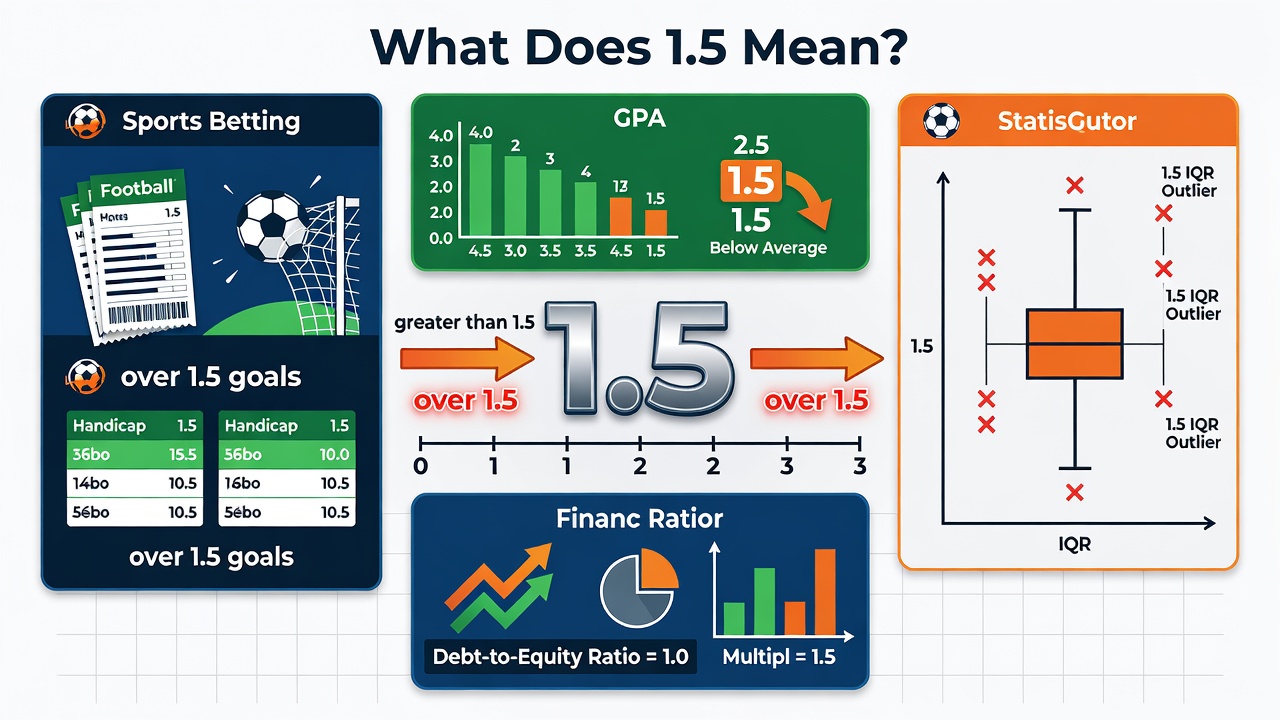
A single number rarely causes confusion the way 1.5 does. It sits between two whole numbers, refuses to round cleanly in either direction, and shows up everywhere from betting slips to statistical reports to quality control charts. Yet the moment someone asks "what does 1.5 mean" in a specific context, the simple decimal suddenly requires explanation.
The confusion usually starts with comparison language. Saying a value is "over 1.5" or "above 1.5" sounds straightforward until you realize the threshold itself is never actually reached - because 1.5 is a midpoint value in many practical systems, particularly those built around whole-number outcomes. This is exactly why understanding what does over 1.5 mean becomes useful well beyond one specific field; the logic behind it applies to ratings, statistics, and threshold-based decisions of all kinds. Once you grasp the mechanics, the number stops being mysterious and starts being a precise tool.
This piece breaks down the number itself, its role as a boundary line, and why "greater than 1.5" carries such specific weight in decision-making, scoring systems, and data interpretation. By the end, the ambiguity disappears entirely.
Understanding the Basic Meaning of 1.5
Before tackling interpretation, it helps to establish what 1.5 actually represents as a numerical value. It is not an obscure figure - it's the arithmetic midpoint between 1 and 2, expressed as a decimal or equivalently as the fraction 3/2. Despite this simplicity, the number takes on different functional roles depending on the system it appears in.
The Mathematical Definition
Mathematically, 1.5 equals one and a half units. It can represent a measurement, a ratio, a multiplier, or a coefficient. In pure arithmetic, there's nothing ambiguous about it - 1.5 is 1.5, full stop. The complexity enters only when this value gets applied as a threshold or cutoff point within a system designed around whole numbers.
Where 1.5 Commonly Appears
The number turns up in far more contexts than most people realize. Recognizing these patterns helps clarify why the interpretation matters so much.
- Sports betting markets, where totals and handicaps often use half-numbers to avoid ties
- Academic grading scales and GPA calculations
- Engineering tolerances and material ratios
- Financial multipliers, such as valuation ratios or leverage figures
- Statistical thresholds in research, including standard deviation cutoffs
Why Half-Numbers Are Used Deliberately
Systems that rely on whole-number outcomes - goals scored, points earned, items counted - often adopt half-number thresholds specifically to prevent a draw or an unresolved result. Since no whole number can equal 1.5, any outcome measured against it must fall either above or below. This design choice removes ambiguity entirely, which is the opposite of what confuses newcomers at first glance.
What Does 1.5 Mean in Context?
Context changes everything about how 1.5 should be read. The same numeral can signal a rating, a limit, or a statistical benchmark, and the correct interpretation depends entirely on the system applying it.
1.5 as a Rating or Score
In rating systems - product reviews, performance evaluations, risk assessments - 1.5 often sits near the low end of a scale, though its exact position depends on the scale's range. A 1.5 out of 5 signals a weak result; a 1.5 out of 10 signals something closer to a failing mark. What does 1.5 mean in these cases hinges entirely on the scale's ceiling, not the number alone.
1.5 as a Threshold Value
When 1.5 functions as a cutoff, everything above it belongs to one category and everything below it belongs to another. This is the most common source of questions about the number, because thresholds require readers to understand direction: does the category of interest include values above the line, below it, or exactly at it?
1.5 as a Multiplier or Ratio
In financial and scientific contexts, 1.5 frequently functions as a multiplier - a debt-to-equity ratio of 1.5, for instance, means liabilities are one and a half times larger than equity. Here, the over 1.5 meaning shifts from "exceeding a line" to "exceeding a proportional relationship," which changes the stakes of interpretation considerably.
Over 1.5 Meaning: A Closer Look
The phrase "over 1.5" appears constantly in threshold-based systems, and its precise over 1.5 definition depends on strict mathematical logic rather than approximation.
The Strict Mathematical Interpretation
"Over 1.5" means any value strictly greater than 1.5 - 1.51, 2, 3, 100, and so on. It excludes 1.5 itself. This distinction matters enormously in systems where outcomes are measured in whole numbers, because the next possible value after 1.5 is 2. Consequently, "over 1.5" in a whole-number system functionally means "2 or more."
Why the Half-Point Removes Ambiguity
This is the core reason half-number thresholds are so widely used. If a count of events - goals, defects, incidents - must land on a whole number, and the threshold is set at 1.5, there is no possible outcome that lands exactly on the line. The result is either clearly under or clearly over, with zero room for a tie or an undefined case.
Common Misreadings of "Over 1.5"
People sometimes assume "over 1.5" includes 1.5 itself, treating the phrase as shorthand for "1.5 or more." This is incorrect in strict mathematical usage. The word "over" implies exceeding the value, not matching it. Confusing these two readings leads to real errors in interpreting scores, statistics, and threshold-based rules.
Greater Than 1.5 vs. Above 1.5 Interpretation
Though "greater than 1.5" and "above 1.5" are often used interchangeably in everyday language, examining them closely reveals why both point to the same mathematical territory while carrying slightly different connotations.
Are "Greater Than" and "Above" the Same?
Mathematically, yes. Greater than 1.5 and above 1.5 both exclude the value 1.5 itself and include every value beyond it. The words differ only in tone: "greater than" feels more formal and precise, often used in mathematics and statistics, while "above" feels more conversational and shows up more often in everyday reporting, ratings, and casual explanations.
The Role of Inclusive vs. Exclusive Boundaries
Not every system treats boundaries the same way. Some explicitly state "1.5 or greater," which does include the value 1.5. Others use strict inequality, excluding it. This is where careful reading matters - a single missing word changes the entire outcome set. Any accurate above 1.5 interpretation depends on identifying whether the source material uses strict or inclusive language.
Practical Examples of the Distinction
- A rule stating "scores greater than 1.5 pass" excludes a score of exactly 1.5
- A rule stating "scores of 1.5 or above pass" includes a score of exactly 1.5
- A statistical cutoff of "greater than 1.5 standard deviations" flags only extreme outliers, not borderline cases
Practical Applications and Real-World Examples
Numbers gain meaning through use. Looking at concrete situations where 1.5 functions as a working threshold shows how the abstract definition translates into real decisions.
Statistical and Scientific Use Cases
Researchers frequently use 1.5 as a multiplier in outlier detection, such as the well-known interquartile range method, where any value beyond 1.5 times the IQR from the quartiles gets flagged as an outlier. This isn't arbitrary - it's a convention refined over decades of statistical practice because it reliably separates normal variation from anomalies without being overly aggressive.
Everyday Comparisons and Measurements
Outside formal statistics, people use 1.5 constantly in daily estimation - "one and a half times as much," "a page and a half," "1.5 hours." These informal uses rarely require the same precision as strict threshold systems, but the underlying value remains identical.
Why Precision Matters When Interpreting 1.5
Small misunderstandings about whether a boundary is inclusive or exclusive can lead to meaningfully different conclusions, especially in fields where decisions carry financial or evaluative weight. Reading the surrounding language carefully - "greater than," "at least," "above," "or more" - resolves the ambiguity every time.
Frequently Asked Questions
Does "over 1.5" include the number 1.5 itself?
No. "Over 1.5" strictly means values exceeding 1.5, so the number 1.5 itself is excluded. If a system intends to include 1.5, it will typically say "1.5 or more" or "1.5 and above" instead.
Why do so many systems use 1.5 instead of a whole number as a cutoff?
Half-number thresholds prevent tied or undefined outcomes in systems that measure whole-number results. Since no count can land exactly on 1.5, every result falls clearly into one category or the other.
Is "greater than 1.5" the same as "at least 1.5"?
No. "Greater than 1.5" excludes the value 1.5, while "at least 1.5" includes it. This distinction changes which results qualify under a given rule, so it's worth checking the exact wording before applying it.
What does 1.5 mean when used as a multiplier?
As a multiplier, 1.5 means one and a half times the original amount. For example, a value multiplied by 1.5 increases by fifty percent of its original size.
How should I interpret 1.5 on a rating scale?
The interpretation depends on the scale's total range. A 1.5 on a five-point scale suggests a low or unsatisfactory result, while the same number on a ten-point scale sits closer to a failing or very weak evaluation. Always check the scale's maximum before judging the number in isolation.
Can 1.5 ever represent an exact outcome in whole-number systems?
No. In systems that count discrete whole events - such as goals, defects, or occurrences - 1.5 can never be an actual result. It exists purely as a threshold, separating outcomes of 1 or fewer from outcomes of 2 or more.