
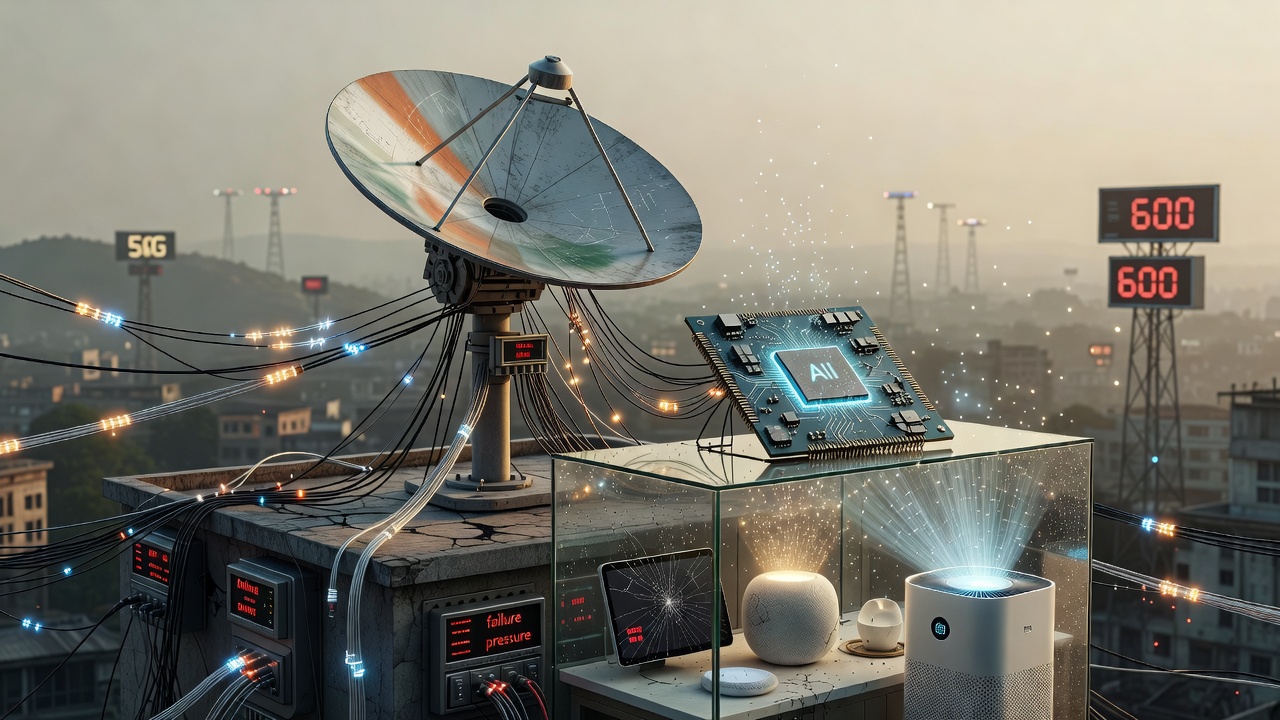
Satellite broadband's arrival in India has turned into a test of sovereignty as much as technology. Elon Musk's public claim that domestic business interests are stalling Starlink's rollout has drawn a sharp response from New Delhi, with Telecom Minister Jyotiraditya Scindia insisting that security and data rules apply equally to every operator, foreign or domestic. The dispute lands just as India's satellite communications sector is projected to grow toward $14.8 billion by 2033, making the stakes for both sides considerable.
What the Government Actually Wants
India's licensing framework for satellite services, built around GMPCS rules, is not a bureaucratic formality designed to slow foreign entrants. It reflects a consistent policy logic applied across telecom and internet infrastructure: any operator carrying Indian communications traffic must be answerable to Indian law enforcement and security agencies in real time. That translates into a short list of hard requirements. Operators must route traffic through local gateway landing stations rather than foreign ones, enable lawful interception on demand, support geographic "beam kill-switches" that can disable service in sensitive zones, and guarantee that no Indian user data is routed or stored outside the country. None of these conditions is unique to Starlink. They mirror obligations already placed on domestic telecom and cloud infrastructure providers, which is precisely the point officials are making when they reject the idea that Starlink is being singled out.
Why the Economics Still Favor Terrestrial 5G
Even if regulatory approval arrives quickly, satellite broadband faces a tougher market reality. Dish-based terminals carry high upfront costs compared with the price of a 5G-enabled smartphone or terrestrial broadband connection, and India's urban and semi-urban markets already have extensive fiber and tower-based 5G coverage expanding fast. Satellite's genuine advantage lies in reaching areas terrestrial networks cannot economically serve: remote villages, hilly terrain, and disaster-hit regions where laying cable or erecting towers is impractical. That niche is valuable, but it is narrower than the headline figures about market size suggest, and it explains why the commercial case for Starlink in India depends heavily on pricing strategy, not just regulatory clearance.
Apple's Smart Home Push Meets a Price-Sensitive Market
Away from the satellite standoff, Apple has unveiled its most ambitious smart home lineup in years. The centerpiece is HomeView, a 7-inch wall- or table-mountable display priced at ₹39,900 that runs Siri and can recognize up to six household members, positioning it as a direct rival to Amazon's Echo Show and Google's Nest Hub devices. Alongside it comes a refreshed Apple TV 4K at the same price point with far-field microphones and precision Find My tracking for the remote, a ₹18,900 HomePod mini 2, and a broader connected-home push built with LG Electronics and Schneider Electric for lighting, appliances, and energy management. The question is whether Apple's premium pricing, well above equivalent Alexa and Google Home hardware, can convert its loyal iPhone user base into smart home customers in a market that has historically favored cheaper, more flexible alternatives.
Clearing the Air Before Winter
With AQI levels beginning their seasonal climb across Delhi-NCR, air purifier demand follows a predictable yearly pattern, and Xiaomi's Mijia Smart Air Purifier 6, priced at ₹19,999, offers a useful benchmark. Its five-stage filtration, combining a primary filter, HEPA, activated carbon, UVC sterilization, and negative ion release, is rated for rooms up to 940 square feet with a 443 m³/h particle CADR. In a controlled candle-smoke stress test, the unit brought an extreme reading of 600 AQI down to 54 within 35 minutes and to 12 within roughly an hour, a result that holds up well against rivals like the Honeywell Air Touch P2. Its 32dB sleep mode and app-based controls make it practical for bedrooms, though buyers should weigh its coverage limits against room size before purchase.
Whether India's security-first approach to satellite internet is prudent caution or costly delay remains an open question, and Apple's bet on premium smart home hardware will be tested against budget-conscious buyers in the months ahead.