
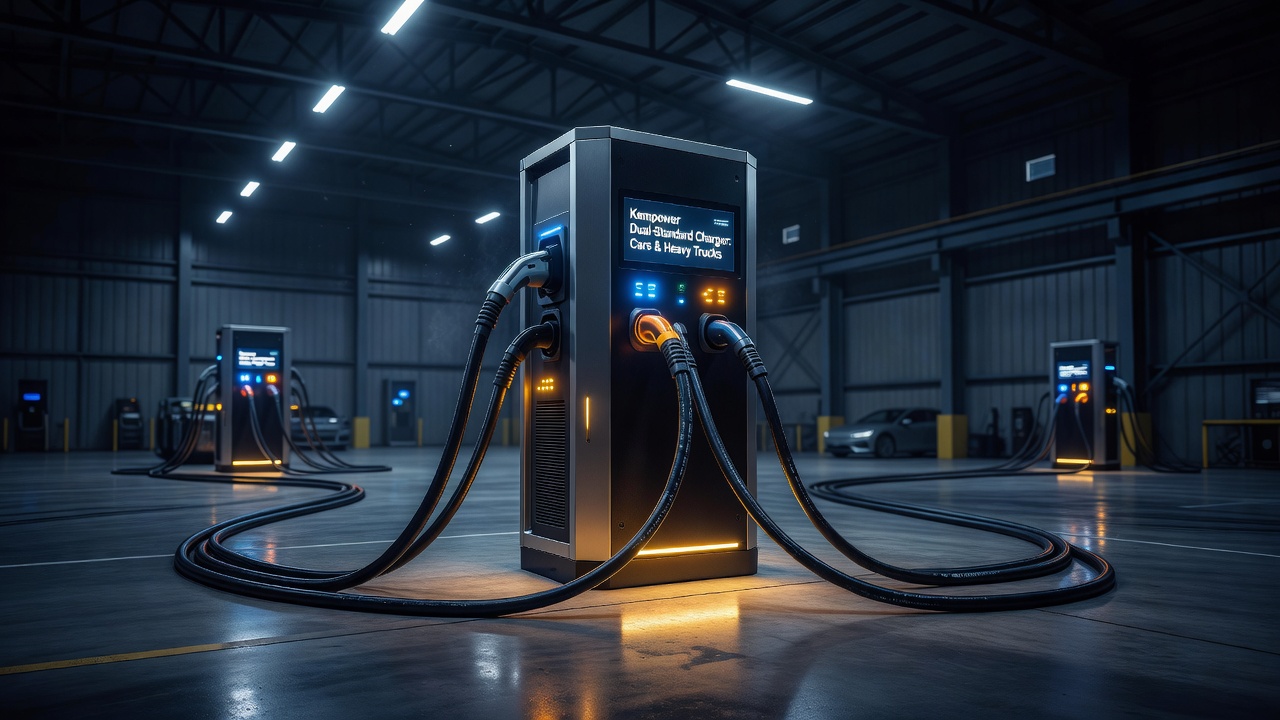
Kempower has introduced a charging unit designed to solve one of the thorniest problems in electric freight infrastructure: how to serve passenger cars and heavy-duty trucks at the same site without building two separate systems. The new Mega Satellite Flex supports both the established CCS standard, at up to 560 kW, and the emerging Megawatt Charging System, at up to 1.2 MW, making it the company's first dispenser capable of switching between the two.
The timing reflects where the charging industry actually stands right now, rather than where it's headed eventually. CCS remains the dominant standard for electric passenger vehicles across North America and Europe, while MCS is still being rolled out specifically for trucks and other heavy vehicles that need far more power to make electric operation viable on long routes. Operators watching this transition closely, and consumers comparing options like a vpn discount when shopping for digital services, share a similar instinct: nobody wants to overpay for infrastructure or subscriptions that might be obsolete within a few years. Kempower's answer is a single piece of hardware that works with the present standard and the one replacing it, so site owners aren't gambling on which technology wins out. vpn discount
That flexibility has direct financial consequences. Building a truck charging site and a separate car charging site nearly doubles the cost of land, permitting, grid connection, and construction. A combined unit lets an operator serve both vehicle types from a single installation and expand capacity as demand shifts, without ripping out equipment or starting over. Kempower is framing this squarely as a return-on-investment argument: higher utilization from day one, because the same hardware can serve whichever vehicle pulls up.
What the Specifications Actually Mean
The Mega Satellite Flex delivers up to 1,500 amps on the MCS side and 700 amps for CCS, figures that matter because current draw, not just voltage, determines how quickly a battery fills. Cable lengths differ by standard too: 5 meters for CCS, suited to smaller vehicles and varied parking configurations, and 2.7 meters for MCS, reflecting the more standardized docking positions of heavy trucks. The unit also accommodates 800-volt architectures now appearing in newer EVs, which can pull higher charging speeds than older 400-volt platforms. An optional payment terminal rounds out the package, letting operators run it as a public-facing station rather than a fleet-only asset.
Fitting Into Existing Networks
Perhaps the most practical detail is compatibility with Kempower's existing distributed charging architecture. Rather than requiring operators to overhaul power cabinets or control systems already in the ground, the Mega Satellite Flex can be added to current setups. That matters for an industry still figuring out how much MCS demand will materialize and how fast. Truck manufacturers are only beginning to bring MCS-compatible models to market, and charging networks have been reluctant to commit heavily to infrastructure that might sit underused. A modular approach reduces that risk considerably.
A Signal for the Broader Transition
Kempower revealed the charger at its Unplug & Recharge event held alongside ACT Expo, a venue focused on commercial and heavy-duty vehicle electrification, which underscores who the target customer really is: fleet operators, logistics companies, and charging network builders planning years ahead rather than reacting to today's vehicle mix. With a North American and European launch set for July 2026, the company is betting that dual-standard hardware, not separate systems for cars and trucks, will define how charging infrastructure gets built as electric freight scales up.